



FBI Raid Tied To Cannabis Business Sends Shockwaves Through Virginia Politics
- Elevated Club NYC

- May 8
- 2 min read
A federal corruption investigation connected to a Virginia cannabis business has suddenly become one of the most politically explosive cannabis stories in the country.
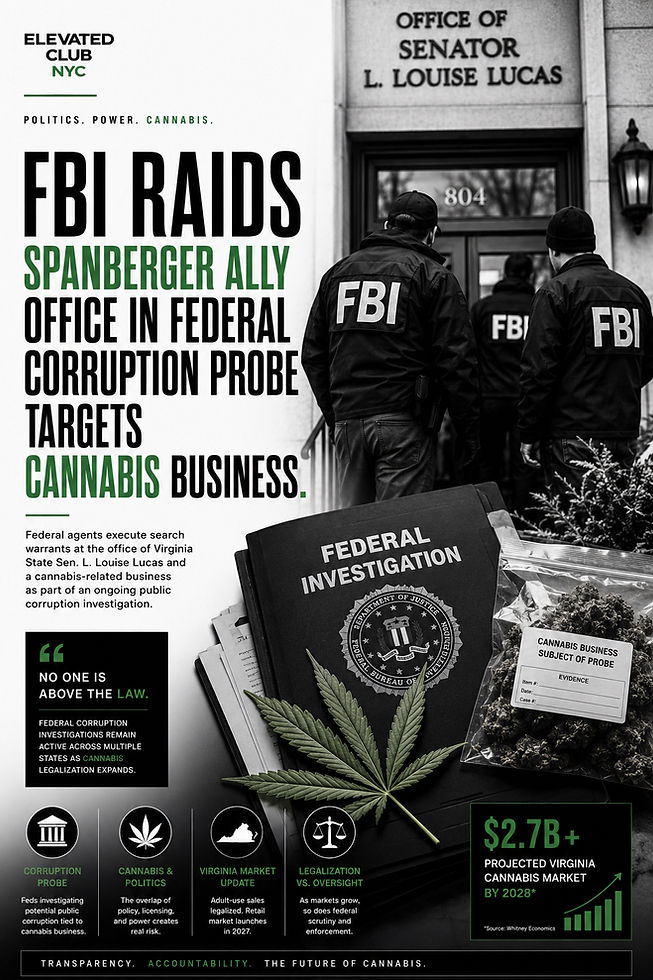
The FBI executed court-authorized search warrants targeting the Portsmouth office of Virginia State Sen. L. Louise Lucas, one of the most powerful Democratic lawmakers in the state and a close political ally of Gov. Abigail Spanberger. Federal agents also searched a nearby cannabis-related business connected to Lucas as part of the widening probe.
The investigation reportedly centers around potential public corruption and marijuana-related business activity, although federal authorities have not publicly detailed the exact allegations or identified formal charges against Lucas herself.
What makes the story significant isn’t only the raid itself—it’s the timing and symbolism surrounding it.
Lucas has been one of Virginia’s most influential Democratic figures for decades and played a major role in shaping the state’s cannabis legalization framework. She also became nationally known after aggressively pushing congressional redistricting efforts designed to favor Democrats in Virginia, making her a major political target among conservatives.
Following the raid, Lucas publicly suggested the investigation may be politically motivated, while Democratic leaders across Virginia questioned the optics of federal law enforcement targeting one of the state’s highest-ranking lawmakers during a highly polarized political moment.
At the same time, the investigation also exposes a deeper issue surrounding cannabis legalization nationwide: the growing overlap between politics, licensing power, business interests, and regulatory influence.
As cannabis transitions from underground markets into billion-dollar legal industries, political influence around licensing, zoning, retail approvals, taxation, and enforcement is becoming increasingly valuable. In emerging legal states, cannabis businesses often depend heavily on local political structures and regulatory relationships simply to operate.
That creates risk.
The Virginia case highlights how quickly cannabis can move from a legalization success story into a federal scrutiny story when politics and commerce become deeply connected.
Virginia itself remains in a complicated cannabis position. While possession is legal, the state still lacks a fully operational adult-use retail market. Gov. Spanberger recently signed legislation legalizing recreational cannabis sales beginning in 2027, potentially setting the stage for a massive expansion of the state’s cannabis economy.
That future market carries enormous financial stakes.
Licensing access in emerging cannabis states can mean millions in future revenue potential, which is why regulatory transparency becomes critically important as legalization expands.
The FBI operation also arrives during a broader national shift in cannabis enforcement and federal oversight. While federal rescheduling conversations continue advancing, investigations involving corruption, licensing practices, and illicit marijuana sales remain active across multiple states.
The contradiction is becoming increasingly clear:
Cannabis is simultaneously becoming more normalized economically while remaining highly vulnerable politically and legally.
For operators and consumers alike, the Virginia raid reinforces a larger reality about modern cannabis markets—legalization alone does not remove institutional risk.
If anything, legalization often creates entirely new forms of political, regulatory, and financial exposure.
At Elevated Club NYC, the focus remains on watching how cannabis evolves structurally—not just culturally.
Because the future of cannabis won’t only be shaped by products or branding. It will also be shaped by power, regulation, and who controls the market behind the scenes.


Comments