



Health Effects of Eating Cannabis: How Edibles Affect The Body Differently
- Elevated Club NYC

- May 10
- 2 min read
As cannabis legalization expands, edible products are becoming one of the fastest-growing segments of the marijuana industry. Gummies, chocolates, beverages, baked goods, tinctures, and capsules are increasingly replacing traditional smoking for consumers looking for discretion, convenience, or smoke-free consumption.
But eating cannabis affects the body very differently than inhaling it.
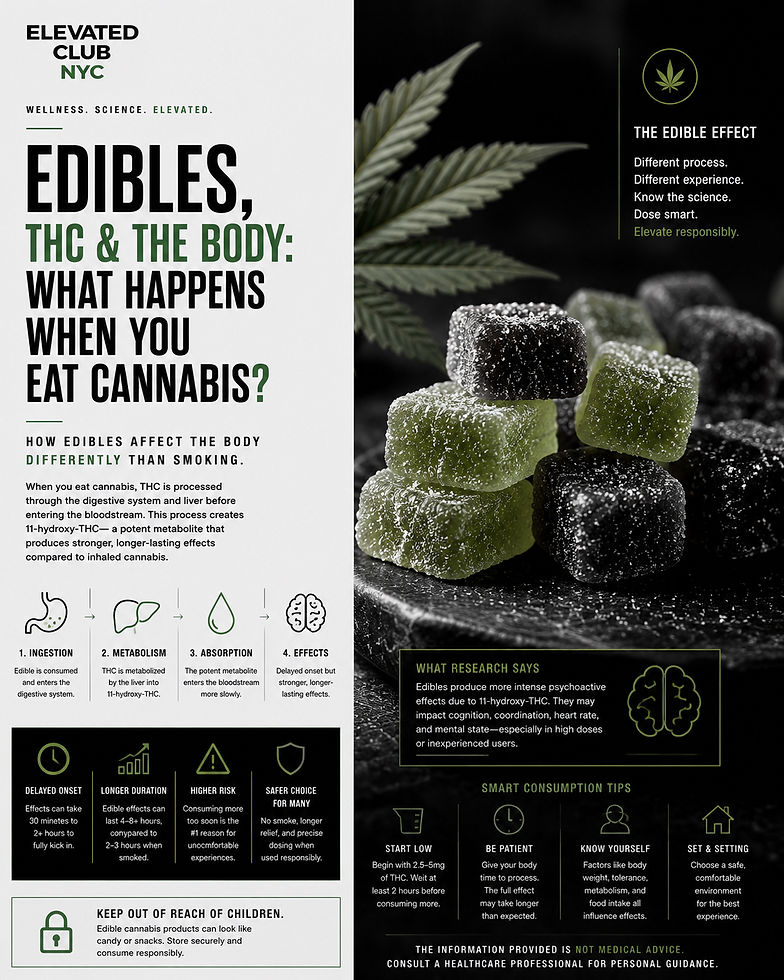
According to medical researchers, THC—the primary psychoactive compound in cannabis—undergoes a unique metabolic process when consumed orally. Instead of entering the bloodstream rapidly through the lungs, THC passes through the digestive system and liver first, where it is converted into 11-hydroxy-THC, a metabolite researchers say can produce stronger and longer-lasting psychoactive effects. (news-medical.net)
That metabolic difference is why edibles often feel more intense, more physical, and significantly longer in duration than smoked cannabis.
Smoking cannabis typically produces effects within minutes, with peak intensity occurring relatively quickly. Edibles, however, may take anywhere from 30 minutes to over two hours before noticeable effects fully appear. (news-medical.net)
That delay creates one of the most common risks associated with edible cannabis: overconsumption.
Many inexperienced users consume additional doses too early, assuming the initial serving “isn’t working,” only to experience unexpectedly strong intoxication later once THC absorption fully activates.
Researchers say high-dose edible experiences can produce anxiety, paranoia, dizziness, impaired coordination, rapid heart rate, and temporary cognitive impairment—especially among inexperienced consumers or individuals sensitive to THC. (cdc.gov)
At the same time, edibles also offer advantages that continue driving market growth.
For medical cannabis patients, edible products provide longer-lasting symptom relief compared to inhaled cannabis. Many consumers also prefer edibles because they eliminate smoke exposure, reduce odor, and allow for more precise dosage control through regulated labeling systems.
The edible market itself has evolved rapidly.
Modern products increasingly focus on low-dose formulations, terpene-enhanced effects, fast-acting nanoemulsion technology, and wellness-oriented positioning rather than simply maximum potency. Microdosing edibles—consuming very small THC doses for subtle effects—is becoming especially popular among newer adult consumers. (forbes.com)
Still, researchers emphasize that edible cannabis should be approached carefully.
Children remain particularly vulnerable because many edible products visually resemble candy or snacks. Public health experts continue warning consumers to store THC products securely and away from minors. (news-medical.net)
Scientists also continue studying the long-term effects of chronic edible cannabis consumption, particularly around cognition, mental health, and cardiovascular response.
The broader shift happening now is cultural.
Cannabis is increasingly moving away from combustion-based consumption and toward more integrated wellness, food, and beverage experiences. Edibles sit directly at the center of that transformation.
For many consumers, cannabis no longer looks like smoke—it looks like functional wellness products, social beverages, sleep support, or curated low-dose experiences.
At Elevated Club NYC, the focus remains on informed consumption, responsible dosing, and understanding how cannabis products interact with the body in real-world use.
Because in modern cannabis culture, the method of consumption shapes the experience just as much as the product itself.


Comments