



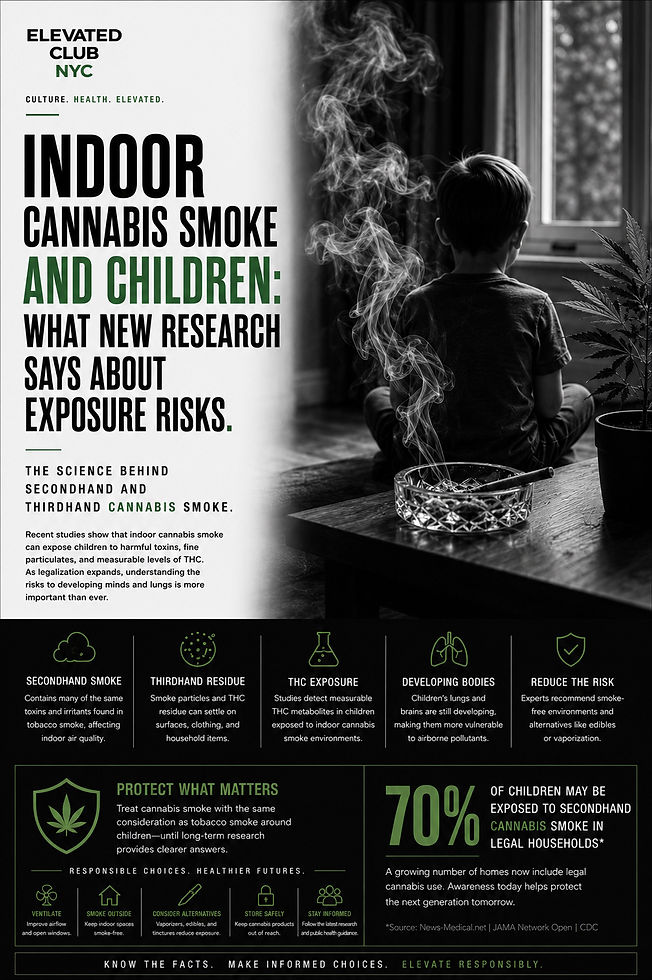
Indoor Cannabis Smoke And Children: What New Research Says About Exposure Risks
- Elevated Club NYC

- May 9
- 2 min read
As cannabis legalization expands across the United States, researchers are increasingly studying a question many households are now facing directly: what happens when cannabis is smoked indoors around children?
According to recent medical research, secondhand cannabis smoke exposure may affect children’s health in ways similar to secondhand tobacco smoke, raising growing concerns among pediatric and public health experts. (news-medical.net)
While cannabis culture has rapidly normalized, the science around indoor exposure—especially involving minors—is still developing.
Researchers say cannabis smoke contains many of the same toxins, irritants, and fine particulate matter found in tobacco smoke, including compounds linked to respiratory irritation and cardiovascular stress. Indoor cannabis smoking can also leave behind residue particles known as “thirdhand smoke,” which may settle on furniture, walls, clothing, and household surfaces over time. (news-medical.net)
One of the biggest concerns involves THC exposure itself.
Several studies have detected measurable THC metabolites in children exposed to indoor cannabis smoke environments, suggesting that passive exposure can result in actual cannabinoid absorption. (jamanetwork.com)
Researchers emphasize that children are physiologically more vulnerable to airborne pollutants because their lungs and neurological systems are still developing. Smaller body size and higher breathing rates relative to body weight may increase exposure intensity compared to adults. (news-medical.net)
At the same time, the research remains incomplete.
Scientists still do not fully understand the long-term developmental impact of repeated secondhand cannabis smoke exposure in children. Large-scale longitudinal studies remain limited due to cannabis prohibition historically restricting research access for decades.
What researchers do know is that indoor air quality matters.
Poor ventilation, enclosed apartments, and repeated smoking sessions can increase particulate concentration significantly indoors. Some public health experts now recommend treating cannabis smoke similarly to tobacco smoke around children until more definitive long-term evidence becomes available. (cdc.gov)
The issue is becoming increasingly relevant because legalization has shifted cannabis use from hidden or isolated behavior into more normalized household consumption patterns. Millions of parents and caregivers now legally consume cannabis in states across the country, creating entirely new public-health conversations around responsible use and exposure management.
The debate also intersects with modern consumption trends.
As legalization expands, some consumers are moving toward lower-odor or smokeless alternatives such as edibles, tinctures, beverages, and vaporization systems to reduce indoor smoke exposure and improve discretion. Public health researchers say these alternatives may reduce airborne particulate exposure compared to combustion-based smoking, though they carry separate considerations and risks. (news-medical.net)
What makes the conversation important is that cannabis legalization is no longer only about adult access—it’s increasingly about how cannabis integrates into homes, families, and everyday environments responsibly.
The science is still evolving, but awareness around indoor exposure is growing rapidly.
At Elevated Club NYC, the focus remains on informed adult consumption, transparency, and understanding how cannabis culture intersects with health, safety, and real-world lifestyle behavior.
Because as legalization expands, responsible consumption becomes part of the conversation too.


Comments