



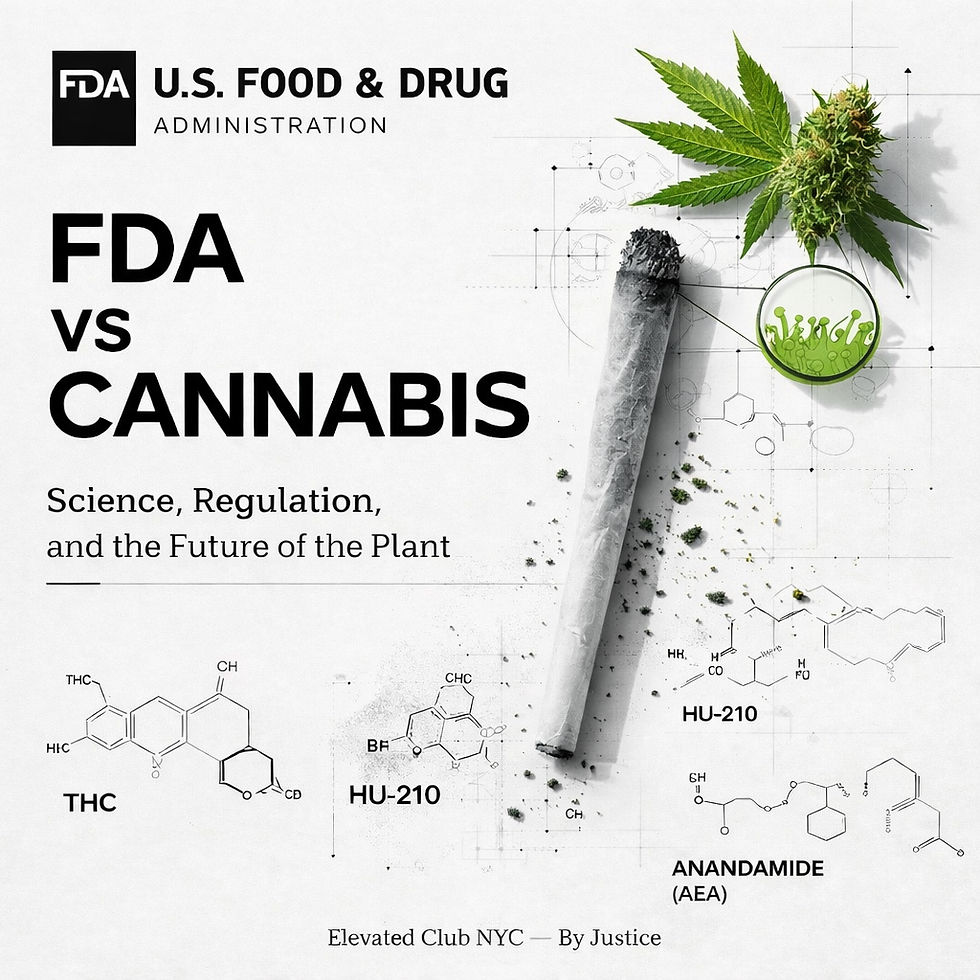
FDA, Cannabis, and the Future of Regulation By Justice — Elevated Club NYC
- Elevated Club NYC
- Mar 14
- 3 min read
For decades, cannabis has existed in a strange space in American law. Millions of people use it, dozens of states have legalized it in some form, and a massive industry has grown around it. Yet at the federal level, cannabis regulation still moves cautiously — especially when it comes to the role of the U.S. Food and Drug Administration.
The FDA’s position on cannabis is often misunderstood. While cannabis may be legal for medical or adult use in many states, the FDA regulates products that claim medical benefits, food safety, and pharmaceuticals. Under the agency’s framework, cannabis itself has not been approved as a medicine to treat diseases or medical conditions. What the FDA has approved are a handful of specific cannabinoid-based pharmaceuticals that went through the traditional drug-approval process.
One of the most well-known examples is Epidiolex, a purified CBD medication prescribed for rare forms of epilepsy. The FDA has also approved synthetic cannabinoid drugs such as dronabinol and nabilone for specific medical uses like chemotherapy-related nausea. These products were approved because they were tested through clinical trials, reviewed for safety, and manufactured under strict pharmaceutical standards.
That distinction matters.
Across the country, consumers can find thousands of cannabis and hemp products marketed for wellness, relaxation, sleep, or pain relief. But from the FDA’s perspective, most of these products exist outside the federal drug approval system. That means the agency has not verified their safety, effectiveness, dosing consistency, or manufacturing quality in the same way it does for prescription medications.
CBD is a particularly complicated case. When the 2018 Farm Bill legalized hemp — defined as cannabis with less than 0.3% delta-9 THC — it opened the door for a massive CBD market. Oils, drinks, gummies, and topicals quickly appeared everywhere from wellness boutiques to gas stations. But the FDA maintains that current food and supplement regulations were not designed for compounds like CBD, especially because CBD has already been studied as a pharmaceutical ingredient.
In 2023, the FDA publicly stated that existing regulatory pathways for foods and dietary supplements are not appropriate for CBD products and that a new framework may require action from Congress. In other words, federal regulators believe the market has grown faster than the rules governing it.
Another area drawing attention is intoxicating hemp derivatives, particularly delta-8 THC. These products are often synthesized from hemp-derived cannabinoids and sold in packaging that resembles traditional snack foods or candy. Federal regulators have issued warnings to companies producing these products, citing concerns about consumer confusion, child safety, and reports of adverse health events.
All of this reflects a broader issue: cannabis regulation in the United States is fragmented. States control retail cannabis markets, while federal agencies oversee drug safety, interstate commerce, and pharmaceutical approvals. That overlap creates a regulatory gray area where cannabis businesses operate under state law but still exist outside many federal regulatory systems.
At the same time, federal policy may be shifting. The Drug Enforcement Administration has begun reviewing a proposal that could move cannabis from Schedule I to Schedule III of the Controlled Substances Act. If that change happens, it could reduce barriers to scientific research and potentially reshape how cannabis is studied and regulated in the future.
For the cannabis industry, the message from federal regulators is clear: science and regulation are catching up to the market, but they are doing so slowly.
At Elevated Club NYC, we believe education is part of elevation. The cannabis conversation is evolving — from prohibition, to legalization, to regulation. Understanding how agencies like the FDA view cannabis helps consumers, businesses, and policymakers navigate the next phase of the industry.
Because the future of cannabis won’t just be shaped by culture or demand.
It will also be shaped by science, regulation, and the rules that determine how cannabis products are studied, labeled, and sold.


Comments