



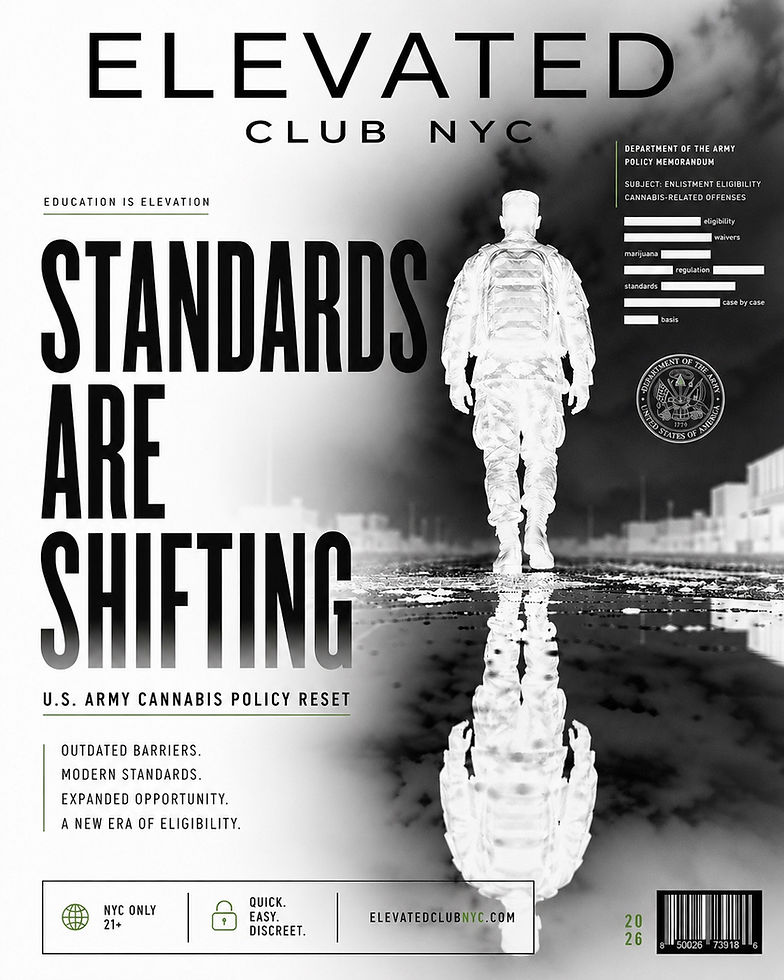
Standards Are Shifting: The U.S. Army’s Cannabis Policy Reset
- Elevated Club NYC
- Apr 26
- 2 min read
The line between prohibition and normalization continues to blur—and now, even one of the most rigid institutions in America is adjusting its stance.
In March 2026, the U.S. Army announced a major shift in recruitment policy: raising its maximum enlistment age from 35 to 42 while simultaneously removing long-standing barriers tied to marijuana-related offenses.
Previously, a single cannabis possession charge could stall a potential recruit for years. Applicants were required to obtain a waiver, wait up to 24 months, and prove eligibility through additional screening. That friction has now been eliminated for minor, one-time offenses—effectively acknowledging what the broader culture already understands: cannabis is no longer a defining disqualifier.
This isn’t about leniency—it’s about alignment.
Across the U.S., legalization and shifting public perception have redefined cannabis from a criminal marker to a regulated substance. The Army’s policy update reflects that evolution. By removing outdated barriers, the institution is recalibrating its standards to match a new social baseline—one where past cannabis use doesn’t automatically signal risk or unreliability.
At the same time, this move is deeply strategic. Recruitment has been a growing challenge, with the Army missing targets in recent years. Expanding eligibility—both in age and background—widens the pool of potential candidates, particularly among a generation that has grown up in a post-prohibition mindset.
But make no mistake: this isn’t a free-for-all. Active-duty drug use remains strictly prohibited, and patterns of substance-related offenses still require review. The shift is not about changing operational standards—it’s about redefining who gets the opportunity to meet them.
There’s a broader cultural signal here.
When institutions built on discipline and regulation begin to reinterpret cannabis policy, it reinforces a larger narrative: normalization is no longer hypothetical—it’s operational. What was once exclusionary is now contextual. What once defined limits now defines potential.
For a city like New York—where cannabis culture intersects with design, wellness, and modern lifestyle—this shift feels inevitable. Standards are evolving everywhere, from federal frameworks to everyday access.
Education is elevation.
And the systems around us are finally catching up.


Comments