



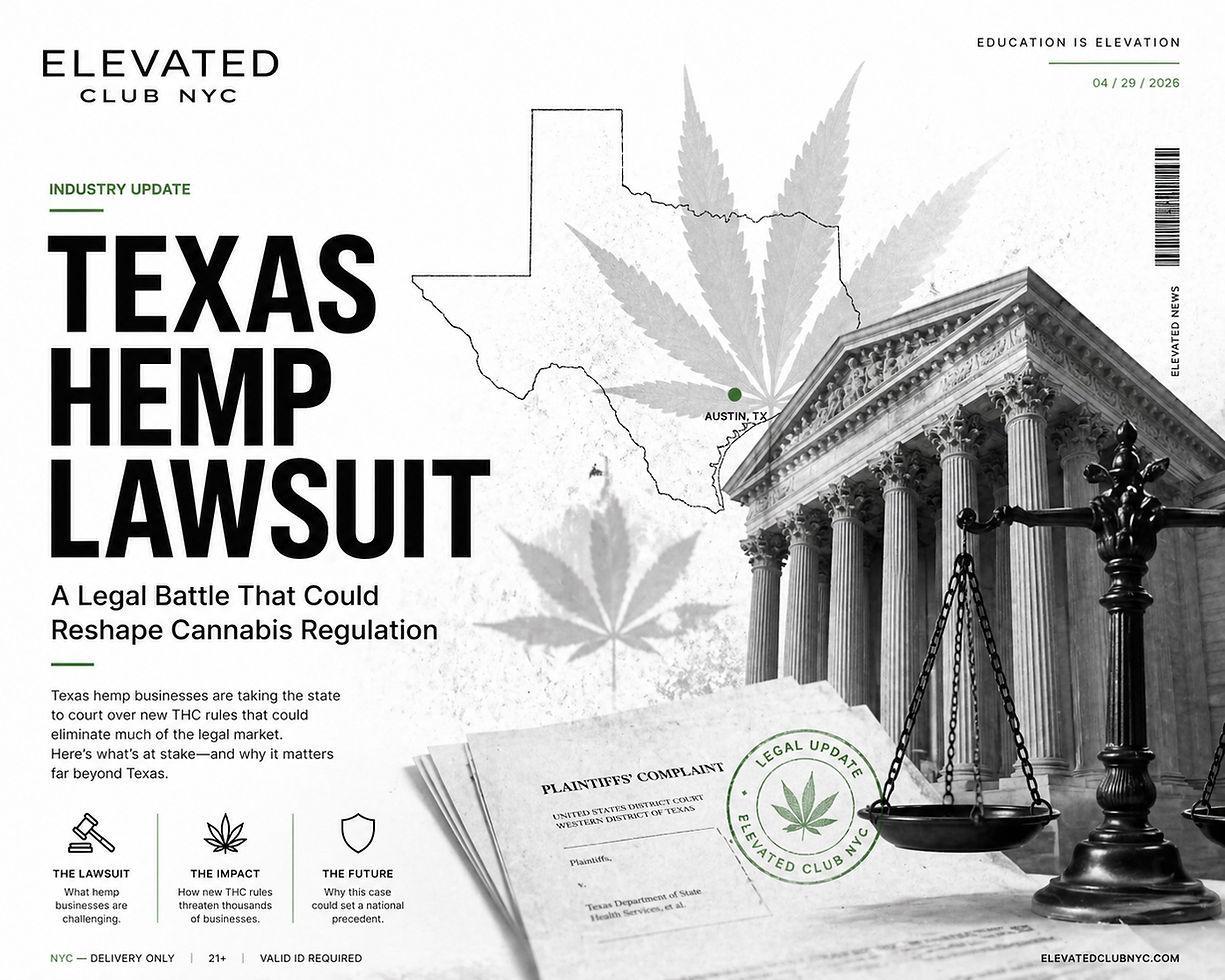
Texas Hemp Industry Lawsuit Signals a Turning Point for Cannabis Regulation
- Elevated Club NYC
- Apr 30
- 2 min read
The cannabis conversation in America is evolving fast—but in Texas, it’s turning into a legal battle with national implications. A group of hemp businesses has filed a lawsuit against the state, challenging new regulations that they say could effectively dismantle the legal hemp market.
At the center of the issue is how Texas defines THC. Since 2019, hemp has been federally and state-legal if it contains less than 0.3% Delta-9 THC. But new rules introduced by Texas regulators expand that definition by factoring in compounds like THCA—an inactive cannabinoid that converts into Delta-9 when heated.
That shift may sound technical, but the impact is massive. By using a “total THC” calculation, the state has effectively banned the sale of smokable hemp products like flower and concentrates—items that make up the majority of the market. Economists estimate smokable products represent up to two-thirds of all hemp sales in Texas, meaning thousands of businesses could be affected overnight.
The lawsuit argues that regulators overstepped their authority, replacing legislative definitions with agency-made rules. It also challenges steep licensing increases—jumping from a few hundred dollars to as much as $10,000 annually for manufacturers and $5,000 per retail location. For small operators, those costs aren’t just regulatory—they’re existential.
There’s also a deeper concern: unintended consequences. Industry leaders warn that eliminating legal access doesn’t eliminate demand—it shifts it. When regulated products disappear, unregulated markets tend to fill the gap, often without safety testing, labeling, or consumer protections.
In a temporary twist, a Texas judge has already stepped in, blocking parts of the rule—specifically the ban on smokable hemp—while the case moves forward. That pause gives businesses breathing room, but the long-term outcome remains uncertain.
For the broader cannabis industry, this case highlights a critical tension: regulation vs. prohibition disguised as policy. As states continue to refine cannabis laws, how they define compounds like THC will determine what remains legal—and what disappears.
At Elevated Club NYC, we’re watching closely. Because what happens in Texas doesn’t stay in Texas—it shapes the future of cannabis nationwide.
Education is elevation. — Justice, Elevated Club NYC


Comments