



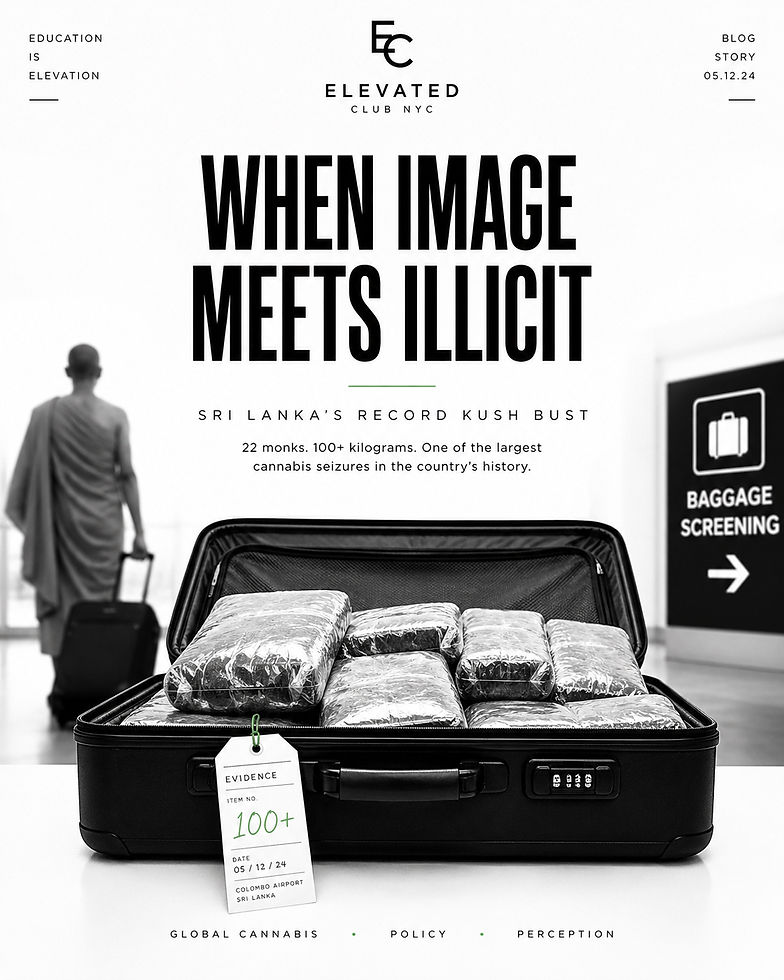
When Image Meets Illicit: What a Record “Kush” Bust in Sri Lanka Says About the Global Cannabis Narrative
- Elevated Club NYC
- Apr 27
- 2 min read
In a headline that feels almost surreal, authorities in Sri Lanka recently arrested 22 Buddhist monks at a major international airport following a record-breaking drug bust involving “kush,” a potent cannabis-derived substance. According to CBS News, the group was returning from Thailand with the substance concealed in their luggage—marking one of the largest seizures of its kind in the country.
Each individual reportedly carried several kilograms of kush, hidden within false compartments, totaling over 100 kilograms seized in a single operation. The scale alone is enough to grab global attention—but the deeper story is what this moment reveals about how cannabis, perception, and prohibition intersect worldwide.
Let’s be clear: this isn’t a story about cannabis culture as New Yorkers understand it. This is about unregulated global markets, where legality, enforcement, and stigma vary dramatically from region to region. In places like Sri Lanka, cannabis remains illegal, and penalties for trafficking are severe. Meanwhile, in parts of the United States—including New York—the plant is increasingly normalized, regulated, and integrated into legitimate business ecosystems.
What makes this story especially striking is the symbolism. Monks—figures associated with discipline, spirituality, and detachment—are not typically linked to international trafficking networks. Yet this incident highlights a broader truth: when markets are pushed underground, anyone can become a participant—willingly or otherwise.
Globally, cannabis still exists in a fragmented legal landscape. In Thailand, where the group reportedly traveled, cannabis laws have shifted rapidly in recent years, creating gray areas that can be exploited or misunderstood. That ambiguity, combined with strict enforcement elsewhere, creates the perfect conditions for high-risk movement of product across borders.
For Elevated Club NYC, stories like this reinforce a core principle: structure matters. Legal, regulated access reduces the need for underground supply chains and the risks that come with them. Transparency, testing, and accountability aren’t just business advantages—they’re safeguards for consumers and communities alike.
This isn’t just about a headline or a shocking arrest. It’s about the ongoing global transition of cannabis—from prohibition to policy, from stigma to structure. And until that transition becomes consistent worldwide, stories like this will continue to surface.
New York is building something different. And that difference matters.
Education is elevation. — Justice, Elevated Club NYC


Comments